ABOUT
About this spot
The flat grassland that spreads at the foot of Mount Hokyo, south of Mount Tsukuba, was once the castle of the Oda clan, who ruled southern Hitachi. Walking it today it looks like a spacious park, but you can trace the earthen ramparts, the moats and the layout of the main enclosure on the ground, which lets you feel the skeleton of a medieval castle. The area of about 21.5 hectares around the ruins was designated a national historic site on June 7, 1935.
Oda Castle's beginnings go back to the Kamakura period. In 1185 Hatta Tomoie was appointed military governor of Hitachi Province and is said to have built a residence at Oda, becoming the founder of the Oda clan. In the Northern and Southern Courts period Oda Hisaharu sided with the Southern Court, so the castle became a Southern Court stronghold in southern Hitachi. Kitabatake Chikafusa landed at Shida-no-sho and then entered Oda Castle, where he is said to have written the Jinno Shotoki, which argues for the legitimacy of the Southern Court. Kasuga Akikuni also entered the castle, and it became a stage for the Southern Court's campaigns.
The lord of the Sengoku period was Oda Ujiharu. Surrounded by the Satake, Yuki, Tagaya and Makabe clans, Uesugi Kenshin and the Later Hojo, the castle fell many times. In 1564 he was defeated by Uesugi Kenshin at the Battle of Sannodo, and after the defeat at the Battle of Tebasaka (its date is disputed) the castle eventually passed to the Satake clan. In 1590 Ujiharu did not join the Odawara campaign and instead rose against the Satake to try to retake the castle, so his domain was confiscated and the Oda ceased to exist as a daimyo family. The castle was abandoned in 1602 when the Satake were transferred to Akita.
Knowing the scale changes how it looks. In the Sengoku period it was expanded into a flatland castle of about 40 hectares, and excavations revealed triple moats and enclosures of various sizes laid out over 500 meters east to west and 600 meters north to south. The main enclosure is a square of about 120 meters east to west and 140 meters north to south, surrounded by ramparts and a moat, with a turret platform at a corner. The gate entrances had umadashi (barbican) and masugata (square) structures, and the bottom of the water moat is said to have been of the shoji-bori (partitioned) type; remains of a garden with two ponds were also found in the main enclosure.
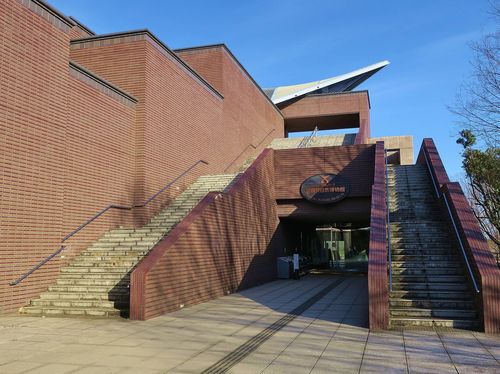
The restoration took a long time. In 1983 Tsukuba City drew up a conservation and management plan, excavations took place in 1997, and a full-scale long-term survey began in 2004. Restoration proceeded from the results, and the site opened on April 29, 2016 as the "Oda Castle Ruins History Plaza." The Oda Castle Ruins History Plaza Information Center at the site presents the roughly 400-year history of the 15 generations of the Oda clan in scroll-like form, along with many displays reporting on the excavations. If you take in the history at the information center first and then walk the ruins, the meaning of the undulations in the ground becomes clear.
Allow about one to two hours for the displays and a walk around the ruins. Since you walk outdoors, dress for the season and bring something to drink. The information center's hours may change, so check by phone (029-867-4070) before you go.
By bus, take the Tsukuba City Oda Shuttle from Tsukuba Station on the Tsukuba Express to Oda-Tobu or Oda-Chubu and walk 5 minutes, or take a Kanto Railway bus (bound for Tsukubasan-guchi or Shimotsuma Station) from JR Tsuchiura Station to Oda and walk 10 minutes. By car, it is about 9 km from Tsuchiura-Kita IC on the Joban Expressway, and you use the information center's parking lot. Mount Tsukuba and other sights are in the area and combine well with a trip around Tsukuba.
Sources
This article was written from the official, municipal and tourism-association sources above, and checked against them separately from the writing. Editorial policy
Last updated November 16, 2026