ABOUT
About this spot
Takamatsu Castle, also called Tamamo Castle, stood in Tamamo-cho in Takamatsu, Kagawa Prefecture. It is a National Historic Site, is maintained today as Tamamo Park, and is one of Japan's 100 Fine Castles. The name Tamamo is said to come from a verse in the Man'yoshu in which the poet Kakinomoto no Hitomaro used the phrase tamamo-yoshi as an epithet for Sanuki Province, and from the fact that the sea around the castle was once called Tamamo no Ura.
The castle was built by Ikoma Chikamasa, who was granted the whole of Sanuki Province after Toyotomi Hideyoshi's conquest of Shikoku. Work began at Tamamo no Ura in 1588. In 1642, in the Edo period, Matsudaira Yorishige, a son of Tokugawa Yorifusa, the first lord of Mito Domain, entered the castle with a 120,000-koku fief and began improving it. Much of what survives today was shaped under the Matsudaira family. The castle was abolished in 1869 when the domains were returned to the emperor, and the keep was torn down in 1884 because of its age.
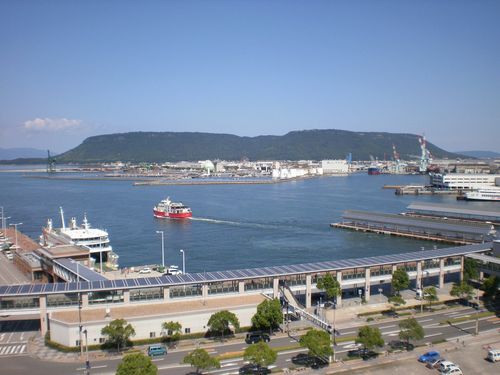
The castle's greatest distinction is that it was built facing the sea and is counted as one of Japan's three great water castles. Its walls once faced the Seto Inland Sea directly, and seawater was drawn into the moats so that ships could enter the castle itself. Seawater still flows into the moats today, connected to the Seto Inland Sea by a sluice gate. Sea fish and shellfish, including sea bream and black sea bream, live in them, and sea bream gather near the sluice gate. The Mizunote Gate in the Kita-no-maru opens toward the sea, and the lord is said to have boarded a small boat there to reach a larger ship offshore. The Tsukimi Turret beside it is said to take its name from the custom of watching for the lord's boat to arrive.
The Important Cultural Properties are the Tsukimi Turret, Mizunote Gate and the Watari Turret (a connecting turret) in the Kita-no-maru, and the Ushitora Turret in the Sakura-no-baba, which was originally in the Higashi-no-maru and was later moved to its present site. The Hiunkaku in the Sanno-maru, built in 1917 as the Matsudaira family's villa in Takamatsu, is a large wooden Japanese-style building. It was designated an Important Cultural Property in 2012, and its garden became a National Place of Scenic Beauty in 2013. The Sakura Gate at the entrance of the Sanno-maru burned in the 1945 air raid on Takamatsu and was rebuilt in wood in 2022.
The Sayabashi bridge, linking the main enclosure and the second enclosure, is a covered corridor bridge with a roof and side walls, named after a sword scabbard. It began as a bridge without a roof, and is thought to have been roofed around the middle of the Edo period. The Sakura-no-baba is, as the name says, a place planted with cherry trees and is known as a spot for spring blossom viewing. The keep no longer exists, but its platform remains.
The interiors of buildings such as the Tsukimi Turret are open only on certain days. Access and conditions in the park may change, so please check the official website before visiting.
Sources
This article was written from the official, municipal and tourism-association sources above, and checked against them separately from the writing. Editorial policy
Last updated November 12, 2026