ABOUT
About this spot
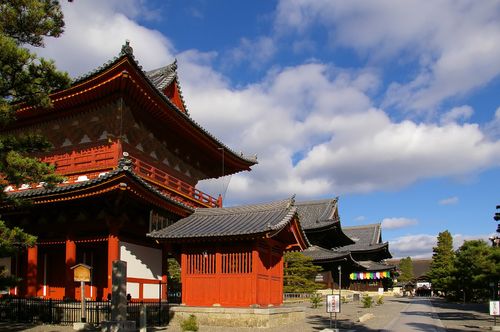
Step off the Randen (Keifuku Arashiyama Line) at Uzumasa-Koryuji Station and in about a minute you stand before the temple's two-story gate. The temple's mountain name is Hachiokayama, its principal image is Prince Shotoku, and it is an independent temple with Shingon roots. It was the clan temple of the Hata family, a lineage of immigrant origin, and is said to be the oldest temple in Kyoto Prefecture, older than the capital of Heian-kyo itself.
The Nihon Shoki records that in 603 Hata no Kawakatsu received a Buddhist image from Prince Shotoku and built the temple called Hachioka-dera. Some accounts date its founding to 603, others to 622. The temple is believed to have first stood elsewhere and to have moved to its present site around the time the capital moved to Heian-kyo. A fire in 818 destroyed the original buildings, and Dosho, who became chief administrator in 836, worked to restore it and is revered as its restorer. The temple burned to the ground again in 1150, but the halls were dedicated anew in 1165. In the Edo period it was counted among the "Seven Great Temples" institutionalized by Retired Emperor Gomizunoo.
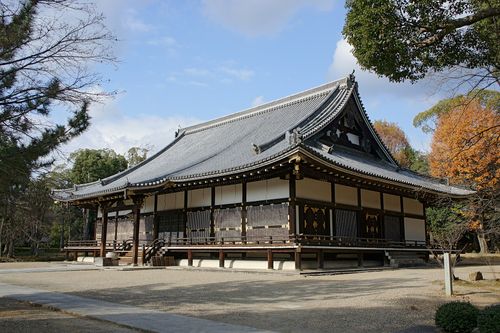
Straight ahead from the approach stands the main hall, the Jogu-oin Taishiden, built in 1730. It is a palace-style hall with a hip-and-gable roof covered in cypress bark, and is also known as the "Taishi-do of Uzumasa." The principal image inside its shrine is a standing statue of Prince Shotoku, 148 cm tall, bearing an inscription of the sculptor Raihan dated 1120 and said to show the prince at age 33. A hidden image, it is dressed in the kojizome imperial robe that emperors wear at major ceremonies such as accession, and the shrine is opened only on November 22. Beside it stands the Kodo, nicknamed "Aka-do" (Red Hall) for its red paint. An Important Cultural Property, it is said to have been rebuilt in 1165 and is regarded as the oldest building in Kyoto City. Inside the inner sanctuary are a national-treasure seated Amida Nyorai (thought to date from around the Jowa era) flanked by seated Jizo Bosatsu on the right and seated Kokuzo Bosatsu on the left, both Important Cultural Properties. Visitors cannot enter the hall and view it from outside.
The highlight for Buddhist sculpture is the New Reiho-den, built in 1982. It houses two national-treasure Miroku Bosatsu statues in the half-seated pose. The "Hokan Miroku" (Crowned Miroku), a single-block carving in red pine from the 7th century, is widely thought to have been brought from the Korean peninsula. The other, the "Naki Miroku" (Weeping Miroku), is camphor wood and is believed to have been made in Japan. The hall also holds the 313.6 cm standing Fukukenjaku Kannon and the 266.0 cm standing Senju Kannon, both national treasures, as well as twelve standing Divine Generals attributed to the sculptor Chosei in 1064. The Crowned Miroku had a finger broken in 1960, and it has since been restored.
The grounds also hold the national-treasure Keigu-in Main Hall (the inner sanctuary). It is a light hall roofed in cypress bark, built in a purely Japanese architectural style and estimated to date from around 1251. The grounds also include the Uzumasa-den, which enshrines Hata no Kawakatsu. The "Ushi-matsuri" (Bull Festival), one of Kyoto's three strange festivals, was last held regularly in 2003 and is now held irregularly.
Toei Uzumasa Eigamura film park is about 130 m away, and Myoshin-ji (about 1.5 km) and Ninna-ji (about 1.8 km) make a half-day route linking the old temples of western Kyoto.
Sources
This article was written from the official, municipal and tourism-association sources above, and checked against them separately from the writing. Editorial policy
Last updated November 5, 2026