ABOUT
About this spot
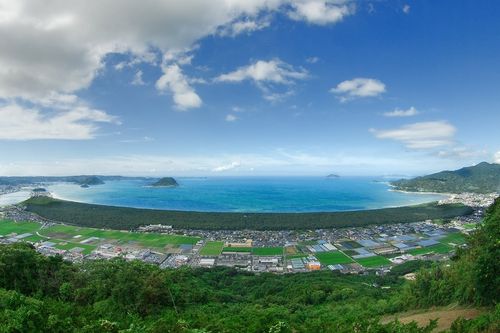
Karatsu Castle was built on Mt. Mitsushima facing Karatsu Bay in Karatsu, Saga Prefecture, and is also called Maizuru Castle. Mt. Mitsushima is 42 meters high, with the main enclosure on its summit and the second and third enclosures strung out on the sand dunes spreading to the southwest, making this a hill-and-plain castle. The alternate name Maizuru, "dancing crane," is said to come from the pine groves spreading east and west of the hill, likened to a crane spreading its wings. The castle site is a historic site designated by Karatsu City, and it was designated in 2019.
The castle was built by Terasawa Hirotaka, a retainer of Toyotomi Hideyoshi. He was granted Karatsu in 1595, sided with the Eastern army at the Battle of Sekigahara in 1600, received an additional 40,000 koku in Amakusa, Higo Province, and became an outside daimyo with 123,000 koku. The castle is said to have been built between the 7th and 13th years of Keicho (1602 to 1608). During construction, Mt. Mitsushima, which had been joined to the East Karatsu side, was cut off, and the Matsuura River was redirected to flow into Karatsu Bay. The Nijinomatsubara pine grove spreading across the river is a nationally designated Place of Scenic Beauty, and Terasawa Hirotaka's protection and cultivation of the pines as a windbreak is said to have led to its formation.
The layout has features typical of a castle facing the sea. On the north side, which faces Karatsu Bay, are stone walls built to rise directly from the water. The remains confirmed include the main enclosure at the top, the lower Ninokuruwa (second enclosure) to its south, a belt enclosure linking the two at the rear northwest, and a waist enclosure that wraps around the foot of Mt. Mitsushima along the shore.
The keep is also interesting. A keep platform was built, but no building records, pictures or plans of a keep have been found, and a 1627 shogunate record does not mention one. The present keep is a replica built on the platform in 1966, a reinforced concrete structure with five tiers and five floors above one basement level, designed in the style of the Keicho era. Turrets and gates have also been rebuilt, and the stone walls and moats restored.
Recent excavations are noteworthy as well. Investigations that began with the stone wall rebuilding project found turret bases and stone embankments in several places in the main enclosure, and also the turret base and gate foundation stones of the Ote Gate, confirming for the first time Edo-period remains shown on old maps. Near the keep platform, a buried older stone wall predating the present one was found, and gold-leaf roof tiles related to Nagoya Castle were unearthed. It has therefore been suggested that some base of the Toyotomi regime existed before the Keicho-era construction, and the date of the castle's construction has been questioned.
The Terasawa family died out in 1647, and the Okubo, Ogyu-Matsudaira, Doi, Mizuno and Ogasawara families later held the castle. It was abandoned in the early Meiji era and developed as Maizuru Park in 1877, and today it remains a place of relaxation for residents and travelers. It has also been selected as one of the Continued 100 Fine Castles of Japan. Check the official guidance for the access status of the keep and park before you visit.
Sources
This article was written from the official, municipal and tourism-association sources above, and checked against them separately from the writing. Editorial policy
Last updated November 12, 2026