ABOUT
About this spot
Shoren-in is a Tendai-school monzeki temple at the foot of the Higashiyama hills, just north of Chion-in in Kyoto. Because sons of the imperial family and of the regent houses served as its head priests, it is also called Awata Gosho, "the Awata Palace," and it ranks with Kajii (Sanzen-in) and Myoho-in as one of the three Tendai monzeki. Its principal image is Shijoko Nyorai.
The temple traces its origin to Shoren-bo, a cell that Saicho built in the southern valley of the East Pagoda precinct on Mount Hiei. In the late Heian period it moved down to Sanjo-Shirakawa, and in 1150 Retired Emperor Toba and Bifukumon-in made it their place of prayer, which strengthened its character as a monzeki temple headed by members of the imperial family. In the Kamakura period it moved to its present hillside site to avoid flooding of the Shirakawa River. The name "Shoren-in Monzeki" is said to appear for the first time in a decree of Retired Emperor Gosaga in 1248. Its head priests included Jien, the author of the Gukansho; Prince-Priest Son'en, regarded as the founder of the Shoren-in style of calligraphy; and Ashikaga Yoshinori (Gien), later a shogun. The temple is also known as the place where Shinran, founder of Jodo Shinshu, is said to have been ordained.
The first building to catch the eye is the Shinden, the largest hall in the compound. Its wall paintings, "Pine Trees on the Beach" (Hamamatsu-zu), are an Important Cultural Property, and in front of it stand the Ukon no Tachibana (orange tree) and Sakon no Sakura (cherry tree). When the Imperial Palace burned in the great fire of 1788 (Tenmei 8), the temple served as the temporary residence of Retired Empress Go-Sakuramachi, and it is designated a national historic site as the "Former Temporary Palace of Shoren-in." The Koshoin was used as her temporary residence, and the Kobuntei tea house served as her study. Both were lost and later restored: the Koshoin was rebuilt with a mid-Edo-period building moved here, and the Kobuntei, destroyed in an arson attack in 1993, was reconstructed in 1995. The Kacho-den (Shiro-shoin) has 60 sliding-door panels with lotus paintings by Kimura Teruki, and the Kobuntei holds 13 wall paintings by Uemura Atsushi.
The garden is a strolling garden centered on a hill-and-pond garden attributed to Soami of the Muromachi period (with Ryushin Pond and Kokyo Bridge) and the "Kirishima Garden" attributed to Kobori Enshu of the Edo period. The Kirishima Garden is planted with Kirishima azaleas, as its name suggests. Five camphor trees, designated natural monuments of Kyoto City, rise in the western part of the grounds, and a great tree said to have been planted by Shinran serves as a landmark of the temple, although the trees are said to predate the temple's move to its present site.
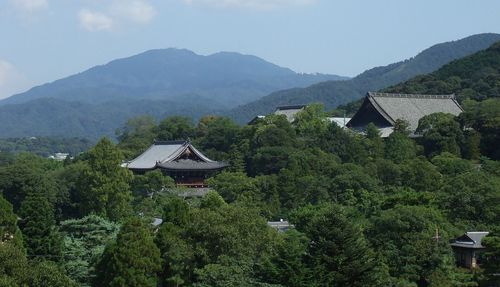
The temple preserves the national treasure "Fudo Myoo and Two Attendants, color on silk," the late-Heian Buddhist painting commonly called the Blue Fudo (Ao-Fudo), counted among the three famous Fudo images of Japan. It is enshrined at Seiryu-den (built in 2014), a detached precinct beside Shogunzuka on the summit of Higashiyama. From the large veranda of Seiryu-den you can look over the Kyoto basin, and the garden there is planted with cherry and maple trees.
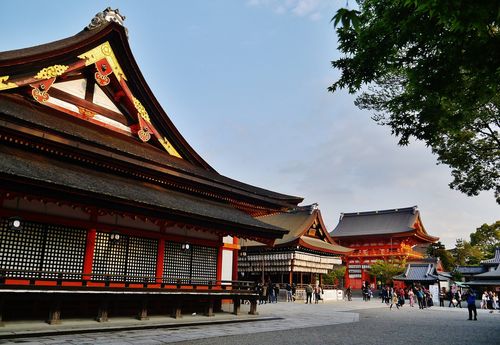
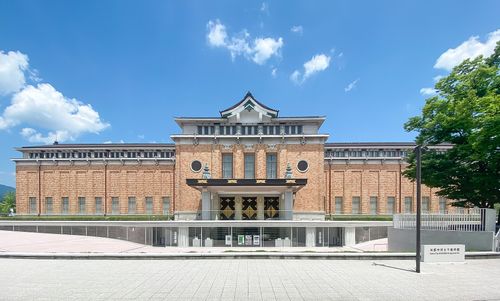
Allow about an hour to see the main sights in order. Special openings are held in spring and autumn, when you can enjoy matcha at the Kobuntei in a corner of the garden while looking out over the grounds. Combined with nearby Chion-in, Yasaka Shrine, and the National Museum of Modern Art, Kyoto, it makes an easy half-day walk through Higashiyama.
Sources
This article was written from the official, municipal and tourism-association sources above, and checked against them separately from the writing. Editorial policy
Last updated November 5, 2026