ABOUT
About this spot
Aoshima is a small island off the Nichinan Coast in Miyazaki City, Miyazaki Prefecture. A bridge called Yayoi Bridge connects it to the opposite shore, Aoshima Beach. The whole island lies within the Class 1 Special Zone of Nichinan Kaigan Quasi-National Park, and Aoshima Shrine stands on it. Just by crossing the bridge, you pass from the scenery of the coast into an island world covered with subtropical plants.
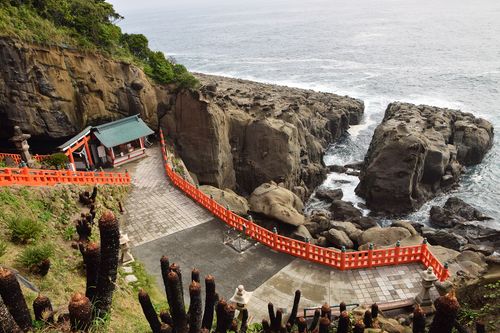
The island's greatest sight is the wave-shaped rock known as the "Devil's Washboard." Around the island, a flat rock platform carved by waves spreads about 200 meters wide, with small, regular undulations running on. It is a formation of alternating sandstone and mudstone; the sandstone, which resists erosion, forms the ridges and the mudstone the valleys, with a height difference of about one meter. The name comes from the way the bumpy rock looks like a washboard. When the tide goes out, a rock bed some 20 to 100 meters wide appears. This landform was designated a National Natural Monument in 1934 as the "Uplifted Sea Floor and Peculiar Wave-Eroded Marks of Aoshima," and in 2007 it was also selected as one of Japan's Top 100 Geological Sites.
The island's plants are also precious. There is a large colony of Chinese fan palms (biro), and around 200 kinds of plants have been recorded. It is regarded as the northernmost subtropical plant community in the northern hemisphere and is designated a Special Natural Monument as the "Aoshima Subtropical Plant Community." It became a Natural Monument in 1921 and was upgraded to a Special Natural Monument, with a change of name, in 1952. As for how these plants took root on the island, one theory says they drifted in on the Kuroshio Current and another says they are relicts that have remained from long ago; the latter is now considered the stronger.
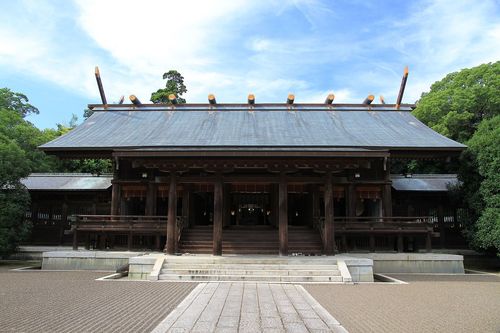
Aoshima Shrine stands on the island. In the past it was a sacred place, and ordinary people could not enter except on festival days. In 1737 the priest Nagatomo Higo petitioned the lord of the Obi domain, and visits were allowed only for a limited period in the second half of the third month of the old calendar; from the Meiji era onward the island became open all year round. The island is also said to have gone by two other names from the Meiwa era until about the Meiji Restoration.
Aoshima has long drawn visitors. In 1907 the crown prince of the time visited, and in 1949 Emperor Showa observed the plants and creatures here. In 1955 the surrounding area was designated Nichinan Kaigan Quasi-National Park. Nearby is Miyakoh Botanic Garden Aoshima (the prefectural Aoshima Subtropical Botanical Garden), so you can enjoy southern scenery together with the island's plants.
The bridge is the present one, rebuilt in 1978. The rock platform around the island changes with the tides and waves, so please check the weather and tide conditions before you visit.
Sources
This article was written from the official, municipal and tourism-association sources above, and checked against them separately from the writing. Editorial policy
Last updated November 12, 2026