ABOUT
About this spot
Tono-no-Hetsuri is a scenic gorge carved by the erosion of the Okawa River (part of the Agano River system) in Shimogo Town, Minamiaizu District, Fukushima Prefecture, and it was designated a national natural monument in 1943. It lies within Okawa-Hadori Prefectural Natural Park and is one of the best-known sights along the Okawa Line. It was designated as a special example of a river-erosion landform.
The rock walls are made of alternating layers of soft Tertiary tuff, tuff breccia and shale. Erosion and weathering have shaped them into columnar cliffs that look like a row of towers. The official explanation says the formations took about a million years to form. The rocks line up over about 200 m, and each one has a name, such as Byobu-iwa, Eboshi-iwa and Goma-to-iwa, which can be identified on the guide illustration.
Hetsuri is a dialect word of the Aizu region meaning a dangerous cliff or steep slope that presses close to a river. Because the official spelling uses a rare kanji, writing it in kana is now common. There were once paths winding around the rocks, but collapses have made many sections impassable. Today visitors can get close as far as the area around the suspension bridge near Butai-iwa.
The scenery changes with the seasons. From spring to early summer, the combination of wisteria blossoms and pale rock faces among fresh green is said to be worth seeing, and the official introduction describes it as a masterpiece of a painting. In autumn, red leaves color the rock walls. The contrast of green or red against the pale rock is said to stand out most in spring greenery and autumn foliage. The whitish rock surface is what appeared as the soft strata were worn away over a long time.
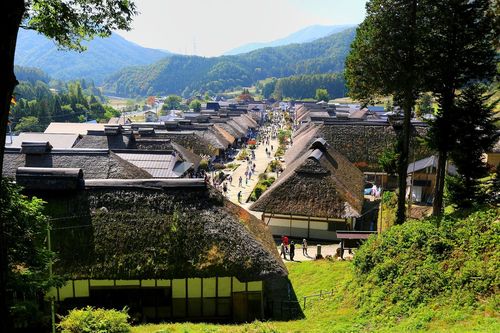
The nearest station is Tono-no-Hetsuri Station on the Aizu Railway, about a 10-minute walk away, and National Route 121 passes nearby. Shimogo Town has other sights such as Ouchi-juku, Yunokami Onsen, Kannonnuma Forest Park and Nakanosawa Kannon-do, and the Michi-no-Eki Shimogo and the town's souvenir hall are also introduced. The manga artist Yoshiharu Tsuge's story Mokkiriya no Shojo is known to have been inspired by a tenugui towel printed in dialect that he bought at a local souvenir shop.
Sources
This article was written from the official, municipal and tourism-association sources above, and checked against them separately from the writing. Editorial policy
Last updated November 12, 2026